Showing posts with label Sisk Mountain. Show all posts

Wednesday, August 4, 2010

Unbelievable! (Sadly... No, It's Not!)


On Tuesday, August 3rd, I got wind of a motion filed by Trans-Canada, the industrial wind developer who is attempting to get a permit to extend its Kibby Mountain project over to Sisk Mountain, in Chain of Ponds Township. This is the letter I wrote in response... and I sent it to each of the state's daily newspapers, asking them to please publish on Wednesday morning.

To the best of my knowledge, no one did.

*********************************************************

At their July meeting, LURC commissioners took a ‘straw vote’ to see how the board stood on Trans-Canada’s permit application to develop Sisk Mountain. After a 5-2 vote to deny, they ordered LURC Staff to prepare a decision document to that effect, with their official vote due to be made at the August 4th meeting in Bangor.

Since that time, the Wind Industry and its supporters have been scrambling, doing their utmost to influence the commissioners’ decision. People and entities such as Professor Orlando Delogu, who prepared reports for the Governor’s Task Force on Wind Power, Jay Wyman, a selectman in the town receiving the most ‘tangible benefits’ from Trans-Canada for the Boundary Mountains project, and Alison Hagerstrom of the Greater Franklin Development Corporation have been inundating the media with commentaries designed to sway the Board’s decision. Like schoolyard bullies who resort to unsavory tactics to make sure their will prevails, the Wind Industry called in its gang.

It was a mistake for the LURC Commissioners to take that straw vote. They opened themselves up to the castigation of industrial wind proponents. In addition, they provided Trans-Canada with a month-long grace period in which they could try to develop a new strategy to compel LURC to vote in their favor.

They certainly were not idly waiting for that official decision. On Friday, July 30th, in an 11th hour move, Trans-Canada submitted a motion to table the vote on the Denial decision and re-open the record so they can introduce an amendment to reduce the number of turbines in the Sisk project from fifteen to eleven, claiming such a change would significantly reduce environmental and scenic impacts.

In reality, such a change will simply reduce by a small amount the millions of tax-payer dollars with which Trans-Canada can line their pockets if their strong-arm tactics are successful and they convince LURC to sacrifice that high-terrain peak which casts its shadow over the unique and beautiful Chain of Ponds.

LURC must hold firm, stand up to the bullies, and do what’s right. They must stand by their decision to deny Trans-Canada’s permit application for the development of Sisk Mountain. ‘Might’ must not triumph over ‘right’.

**************************************************************

And THIS is what will be in this morning's Bangor Daily News!


Canadian firm to scale back Kibby Mountain wind project8/4/10 08:37 pm Updated: 8/4/10 08:40 pm
By Kevin Miller
BDN Staff


BANGOR, Maine — A Canadian energy firm is scaling back its expansion plans for Western Maine’s Kibby Mountain wind farm after state regulators made clear that they could not support placing an additional 15 turbines in the area.

TransCanada officials told the Land Use Regulation Commission on Wednesday that they plan to file a revised application removing the four southernmost turbines in the 15-turbine project. The project is proposed for Kibby and Chain of Ponds townships, approximately two miles from the second phase of the Kibby wind farm now under construction.

TransCanada’s attorney outlined the proposed changes on the same day that LURC was poised to deny the company’s permit request at its Bangor meeting. Despite opposition from the project’s critics, commissioners voted unanimously to table the issue in order to allow TransCanada to revise its application.

“This proposal is not lightly made,” said Juliet Browne, who represented TransCanada before the commission.

During a meeting last month, commissioners largely agreed with concerns raised by opponents that the proposed wind farm expansion would harm views from nearby lakes and trails.

In its written recommendation to the commission, LURC staff noted that while both the original Kibby project and the proposed expansion would “significantly compromise views,” the southern seven turbines within the proposed expansion would have “unreasonable adverse impact to the scenic character of the Chain of Ponds and of the Arnold Trail.”

Commissioners also voiced serious concerns that the southern half of the project would have unacceptable effects on the subalpine fir forests and the Bicknell’s thrush, a bird dependent on subalpine fir forests that the state lists as a “species of special concern.”

Several commissioners had indicated last month that they likely could support a project containing just the eight northern turbines because they had fewer effects on scenic views or subalpine forests. Browne said Wednesday that the eight-turbine project was not economically viable, however.

“We think this is very responsive to the commissioners’ concerns about reducing the subalpine impacts, reducing the impacts on Bicknell’s thrush and reducing the visual impacts on Chain of Ponds,” Browne said.

Critics of the 15-turbine project argued unsuccessfully against allowing TransCanada to revise its application so late in the process.

The most forceful statements came from Bob Weingarten, president of the organization Friends of the Boundary Mountains, who criticized TransCanada for seeking to revise and delay the project now after working hard to keep the project on the fast-track for so long.

Weingarten said the company’s inflexibility caused hardship to his small group of volunteers as they tried to share their views with the commission.

“TransCanada had months and months to change their proposal while the record was still open,” Weingarten said. “TransCanada had months and months to listen to the other side.”

The first 22 turbines of TransCanada’s Kibby wind farm are already operating, and the company is building another 22 turbines at the site.

Last month, three protesters with the group Maine EarthFirst! were arrested while blocking the road leading up to the company’s construction site. Maine EarthFirst! and other critics of industrial wind power contend that projects such as TransCanada’s destroy mountaintops and do little to offset the use of fossil fuels.

**********************************
Unbelievable! And yet, sadly... it's not.

Sunday, August 1, 2010

How Can We Fairly Fight These People?


I'm at a loss. I really am. Almost daily, proponents of industrial wind are granted a forum in our state's newspapers. We who oppose are (sometimes) allowed to post comments and rebuttals online, but the readership of those comments is small, while the number of those who read the paper (both online and in print) is exponentially much larger. On occasion, we can get a short, 300 word letter to the editor published, but it is almost impossible to convey necessary facts when we are so limited.

Professor Orlando Delogu wrote an article printed in today's Portland Press Herald, Maine's largest newspaper. I take exception to much of what he said. And... ME being ME, I had to write an article to rebut some of his statements.

The question that now presents itself is: Will the PPH grant ME a forum, like they did for Mr. Delogu? He is a 'professor emeritus' while I have a simple name with no title to follow it. I'd briefly considered adding "NIMBY Emeritus" after my name, just to see if that got a rise out of anyone at the newspaper, but decided against it. I want them to take me seriously, after all.

This is serious business.

Below is the commentary I've written. I'll try to submit it-- or some edited form of it-- to the PPH. We'll see what happens.

I'm not holding my breath.
*****************************************

In Sunday’s Portland Press Herald, Professor Orlando Delogu unjustly railed at the Commissioners of Maine’s Land Use Regulation Commission. I take exception to much of what he wrote, even while respecting the professor’s superior qualifications to address issues of import. The article seems to be nothing but a last ditch effort to influence the vote on the Trans-Canada/Sisk permit application to be cast by the LURC Board on Wednesday.

Mr. Delogu would do well to look back to the time when LURC was formed before he castigates the commissioners for having ‘lack of vision’. LURC was established to “to preserve public health, safety, and welfare; to encourage the well-planned, multiple use of natural resources; to promote orderly development; and to protect natural and ecological values”. In questioning the wisdom of approving another large-scale development of one of Maine’s wild places, LURC is most certainly adhering to its ‘vision’ of protecting natural and ecological values.

While the professor was not on the Governor’s Task Force on Wind Energy, he did participate in the process, having been asked to prepare and present three papers to the full Task Force. “Wind Energy in Maine: An Assessment of Where We are Now” was also published in the Maine Lawyers Review. There seems to be no conflict of interest in his attempts to sway the Commissioners’ votes, so I don’t understand the professor’s castigation of this State entity. Surely his personal reputation will not be diminished if his words and recommendations aren’t given due import when LURC decides the fate of Sisk Mountain.

These are some of the points made by Professor Delogu with which I disagree.

“Mitigation” is not a solution. Maine’s governing bodies have unwisely sanctioned a system of bribery and payoffs to mollify those people and entities who have the courage to stand up and protest when harm is being done to our environment, or when a misguided plan is about to be implemented which will have deleterious effects on the people and natural resources of Maine. The ‘mitigation’ and ‘tangible benefits’ legalized in LD2283 make me ashamed of my leaders. State sanctioned bribery is not a solution.

The professor tries to make readers believe that wind developments will significantly boost Maine’s economy. He does not mention that a large portion of the money used to fund these projects will go directly to China and Denmark, where the turbines are manufactured. He doesn’t tell us that many of the millions spent on the industrialization of our mountains comes from our pockets, to begin with. Without subsidization from the government, developers readily admit that wind energy plants would not be financially feasible. Delogu fails to mention that the construction jobs created are temporary, that many of those workers are not from the localized area of the developments, and that the permanent, full-time jobs are minimal. As an example; the larger, 48 turbine development proposed for Highland Plantation will only provide four to six (4-6) full time jobs. This statistic comes from the developer’s own permit application. And one of those developers, Rob Gardiner, stated in a recorded meeting in Highland that most likely, the permanent jobs provided by the Highland project would not be given to locals, as the jobs are technical in nature. ‘Locals’ apparently aren’t qualified for such positions. In addition, Patriot Renewables, the developer of the Freedom wind project, stated in a public meeting in Carthage that most turbine manufacturers require that their own technicians maintain the turbines for the first couple of years after installation.
I’d like the professor to consider the potential benefits to Maine if those same tax-payer subsidies were used for conservation efforts. With Maine’s aging housing stock, we would reduce our consumption of electricity (as well as fossil fuels) by replacing windows and doors, insulating homes, and replacing inefficient furnaces and hot water heaters. Not only would this be a good way to conserve energy, but it would be great for our economy, as well--putting legions of local contractors, electricians and plumbers to work in a full-time, year-round capacity.

When the professor speaks of how the neighboring communities support the Sisk project, there are some facts that should be taken into consideration. He may have been at the LURC public hearings at Sugarloaf Mountain in May, and if so, I can understand how he might come to that conclusion. Trans-Canada had lined up a very impressive array of witnesses to speak in favor of the project. These witnesses included groups who had benefitted financially from the ‘tangible benefits’ which Trans-Canada handed out, including the Recreation Department in Stratton/Eustis, the Arnold Trail Expedition Club of Eustis, and the manager of Natanis Point Campground, which is on Maine Public Reserved Land. What is interesting is that according to the expedited permitting law, LD2283, it is supposed to be the ‘host’ community which receives tangible benefits, and not the surrounding communities. (See paragraph 3451, section 7, and section 10). In actuality, the existing and proposed industrial wind developments of Kibby and Sisk Mountains are not in the town of Eustis, but in Kibby Township and Chain of Ponds Township. So in this instance, it’s understandable that the ‘surrounding communities’ support the project. It does not affect them directly, and yet, they have been able to receive financial benefits because of it. Even so, I’ve spoken to several people in the community of Eustis. Not all are as enamored of these projects as the Wind Industry would have us believe.

When Delogu implied that Industrial Wind will reduce our dependence on foreign oil, I cringed. That standard tag line has been thrown out by Wind advocates since Day One. In fact, only one percent of our electricity is produced by fossil fuels. Maine uses oil to heat many of our homes, and we use gasoline to run our vehicles. Electricity does not meet those demands. To tie wind in with Maine’s use of fossil fuels is imprudent and misleading, and to suggest that building industrial wind developments on Maine’s mountains will reduce military casualties or bring our soldiers home is unconscionable, and plays on the emotions of the family members of those who are fighting overseas. The two issues are not connected, and I find that even hinting of such things is a callous thing to do.

If the professor has truly done his homework, he will agree that there are significant problems in the assertion that wind energy will reduce carbon emissions. Scientists have come out with studies suggesting just the opposite. Since wind is erratic, intermittent and undependable, back-up generators must be employed for those times when the wind doesn’t blow. Back-up generators are placed in ‘spinning reserve’-- a less efficient and higher-polluting state-- while waiting to be ramped back up during those times when wind generators aren’t producing. In addition, in many places where industrial wind has gotten a stronger foothold, new fossil-fuel-based electrical plants are being built specifically to take up the slack. Wind energy is not currently well-adapted for inclusion into the grid, and this fact makes it not only very expensive, but suggests that wind is not as ‘green’ as our administration and the wind industry like to tout it as being.


There are many, many facts pertaining to industrial wind projects which the people of Maine do not know. The details discussed here are just the tip of the iceberg and I encourage impartial professionals such as Professor Delogu to research the facts and then, from their positions of authority and respect, to disseminate those facts to the citizens of this state. Rather than trying an eleventh hour attempt to influence the votes of state-appointed LURC Commissioners, those with the ability to control a public forum would serve us well to deal in facts obtained from non-biased sources.


***********************************
Photos are of Kibby Mountain, Kibby Township, Maine

Thursday, July 29, 2010

The 99th Post in the 11th Hour...


Wow. It was almost one year ago that I created Grumbles and Grins on the advice of my marketing coach. In the last 11 1/2 months I've written almost 100 articles to post to GAG. Some of them were simple, foolish, silly things designed to bring a smile to my readers. And a few of them were serious, and were intended to make people think about issues which are important in today's world.

In August of 2009, I was not yet embroiled in the effort to stop mountaintop industrial wind. Truthfully, I knew little about it. And when I was first told that Angus King and Rob Gardiner were going to put a "wind farm" on Highland's mountains, I thought it was most likely a good idea. After all, I believed what I'd heard and read in the media-- those words which the administration and the wind developers hope the public will take to heart and accept as truth. Words like 'renewable' and 'green', and phrases like 'reduce our dependence on foreign oil', 'strengthen our national security' and 'help reduce global warming'. What was not to like?

And then, in October, I went to a meeting at the little one-room schoolhouse in Highland Plantation and listened as Rob Gardiner outlined Independence Wind's plans for Stewart, Witham and Bald Mountains, and Burnt and Briggs Hills. More importantly, I listened to the questions asked by those in attendance. And I recorded the forum, too, so that I could have a record of all that was said.

I began to have concerns about the wisdom of such a development. So did many others. Folks began to read up on the problems surrounding other wind developments, both here in Maine, and around the globe. One month later, the Friends of the Highland Mountains was formed in a small living room in Lexington Township; the tiny community adjacent to Highland Plantation. For me, this was a 'first'. I've never been officially involved in any 'activism', per se. I've always voted. And I've always made an effort to educate myself on that which was to be decided in the voting booth. I had always encouraged others to exercise their right and responsibility to 'have a say', and I'd written a few editorials when an issue seemed to warrant a bit of extra attention. But I'd certainly never waged an all-out campaign like the one in which I am now involved.

Why am I doing this? It's certainly not because it's enjoyable. I sometimes think I'd rather get a poke in the eye with a sharp stick than to be doing what I'm doing. This type of effort is all-consumming, because the opposition has money, power and influence. They also have very few scruples. But scruples are something which the Friends of the Highland Mountains DO have. It's easier for us in that regard. Because, you see, we have the FACTS on our side. In order to even scratch the surface of this important issue and get the facts of the matter out to the people of Maine, it takes a tremendous amount of time and resources, and committments from many, many people. We've been so fortunate with our human resources. Many folks from around this state have joined together to protect our natural resources, as well as our wildlife, our quality of place and life, our economy... and our right to 'have a say'.

As an American, I was incensed when I realized how much information was being kept from me and my fellow citizens. I was enraged as I discovered the amount of corruption that is imbedded in my government. And I was appalled at the amount of disinformation and downright lies which were being floated to THE PEOPLE in the hopes that we would accept those lies and roll over quietly. Our administration and the Wind Industry do not want THE PEOPLE to have the cold, hard facts about the misguided and expensive plan to erect 350+ miles of massive wind turbines along Maine's beautiful and unique high-terrain areas.

For if THE PEOPLE knew the truth, they would stop their plan in its tracks!

So, that's what we've been trying to do-- tell the truth. We've written letters to the editor, and articles for magazines. We've gone out into the surrounding towns and given out written information, DVD's and links to other resources.


We've also spoken with some of the gubernatorial candidates and three out of four of our congresssional delegates. We've been trying to educate the general public on the science and economics of Industrial Wind. The facts say: IT DOESN'T WORK. The facts say there are very few redeeming qualities to industrial wind, and that the negative impacts far outweigh the positive benefits. You've heard me say it all before. Ad nauseum. But because our opposition spreads half-truths and sugar-coated tales of the salvation of our planet through wind energy plants, we have to work even harder to debunk those standard tag lines. We have to be tenacious. We have to be committed to being in this for the long haul. And we have to be brave.

This isn't a game. And we aren't selfish people. If anything, I am convinced that our membership is made up of many selfless people who give up their time and money-- and sometimes, their peace of mind-- to do what we believe is RIGHT. What we are is a group of people who are fighting to spread the facts-- the TRUTH-- about this and other industrial wind projects, before our mountaintops are altered and our way of life is gone.

If you are not yet convinced that industrial wind development is a mistake for Maine, I encourage you to contact me at roomtomove@tds.net or call me at (207)628-2070. I would be happy to share what I've learned from experts in every field pertaining to this topic. Rest assured, there will be no pressure. I believe-- and have found-- that every citizen who has been empowered with the facts agrees that the governor's plan is a colossal mistake for the state of Maine. Only those with some kind of a financial stake hold out for 'wind'... and I understand that. I don't like it, but I understand it. Whichever way you lean, you have the right to factual information, and I encourage all citizens to make up their own minds, from a position of knowledge.

My next posting will be my one-hundredth. How wonderful it would be if it was an article announcing that LURC had denied Trans-Canada's application to develop the high-terrain ridges of Sisk, in our Boundary Moutains, which cast their wild and unspoiled shadows over western Maine's Chain of Ponds!


***************************************
Cartoons courtesy of Windtoons.
Photos courtesy of ME.

Wednesday, May 12, 2010

Kill a Baby, but Build an Orphanage


Kill a baby, but build an orphanage…

In the murky world of Industrial Wind permitting, it’s referred to as “mitigation”.

At forty-six, you’d think I would have “seen it all”. That I would be cynical, hardened, and wiser than I am. But I’m not. I’m still naïve; still believe in the innate goodness of all mankind... still believe that there are some things which money can’t buy. Yep, I’m naïve…

But I’m growing out of it fast.

Today, to show support for the citizens opposing the development of another of Maine's beautiful and rugged mountains, I attended the Land Use Regulation Commission’s technical hearing for the Sisk Mountain/Trans-Canada proposal. Three environmentally-minded agencies were opposing a part of the development… not all of it, but a section. Each representative stated their agency’s reasons for opposing the placement of 400' tall turbines on the south end of Sisk Mountain; one of the Boundary Mountains between Maine and Canada, along the historic Arnold Trail. One wanted to protect a rare tree; another, a rare bird; and the third… the wilderness experience in a remote-feeling outpost. After their testimony, Trans-Canada’s razor-sharp attorneys cross-examined them. These same three entities had endorsed the Kibby Mountain project just a few miles away, and the wind developer’s lawyers quoted their testimony given at those hearings back to them.

They made them look like fools.

You know what, though? Those red cheeks and shuffling feet were well deserved. These agencies are each charged with protecting a segment of Maine’s natural resources. In my opinion, they shouldn’t have endorsed the Kibby Project in the first place. They should have been taken to task, should have had their words thrown back at them! And when the Trans-Canada fire got a little too hot, what happened?

Oh, man. I was mad enough to spit nails...

One expert attempted to clarify his agency’s position on the Kibby project. He stated that they never actually ENDORSED the wind turbine development that is being built there… they simply withdrew their opposition because Trans-Canada had enabled them to purchase a large parcel of land elsewhere to put into a conservation easement. They had received “mitigation”, and so they withdrew their opposition. And then that gentleman--that expert--went one step further. He stated that if Trans-Canada wished to offer similar “mitigation” for the Sisk proposal…

Oh, hell.

Before the cross-examination was over, another of the three agencies admitted to the same thing… that they had sacrificed that which they are duty-bound to protect in exchange for something else of value. That the natural resources of Kibby had been important, but not so important that they couldn’t be forfeited if that agency received something bigger and better. It was justified, you see…

It was all for the greater good.

That saddest part of this whole thing? Our government endorses this practice. After all, “mitigation” is written into that misguided Expedited Permitting Law, LD 2283. I believe our administration may even encourage it, since if the opposing parties can reach a “meeting of the minds”, then the desired development is approved that much quicker, LURC is saved the trouble of having to agonize over a decision, and our governor gets closer to reaching his goal of 2,700 megawatts of land-based wind power by 2020.

Mitigation. Kill a baby, but build an orphanage. I guess that makes it all okay.

*******************************************
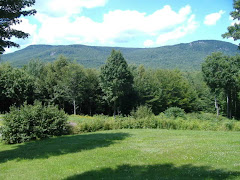
Top photo is of the Boundary Mountains, Maine

Friday, April 23, 2010

Canada Lynx and Industrial Wind


It was almost two years ago that I saw my first Canada Lynx in the wild. You cannot imagine the thrill that gave this game warden’s daughter, who has spent her whole life enthralled with the wildlife of Maine.

If their permit application is approved, Trans-Canada plans to build a grid-scale industrial wind turbine development on Sisk Mountain, one of the Boundary Mountains along the Chain of Ponds, between Quebec and western Maine. The permit states that 17.5 miles of new roads and 17 miles of corridor will have to built and maintained in order for the 15 massive turbines to be brought onto the site, erected, and maintained. These aren’t simply country lanes or skidder trails, either. These roads will permanently fragment prime wildlife habitat.

That big cat had been hunting. She had a rabbit in her mouth and she was running for home. I imagined a litter of lynx kittens waiting in the den, scuffling with each other as they practiced their own hunting and social skills while waiting for their mother to return with their lunch. I was humbled and in awe.

This is the Maine I dream about, and the one in which I was raised. It’s the Maine I now share with my children; the one in which I hope they can rear my grandchildren. If LURC grants Trans-Canada’s permit to place industrial wind on Sisk Mountain, the low and ultra low frequency sound, the shadow flicker, the criss-crossing of hunting trails by 60-150 foot wide roads, and the intrusion of man and his foreign-manufactured machines will devastate the rich habitat that the Canada Lynx has reclaimed as its own.

She had a rabbit in her mouth, and she was taking it home to her babies.


**************************************

Please add your voice of opposition to the industrialization of Sisk Mountain by attending the public Hearing on May 11th and 12th at Sugarloaf Mountain. For more information, please go to lurc@maine.gov.