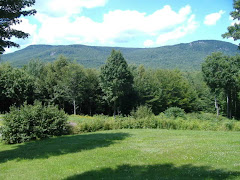
Monday, March 29, 2010

The Land Giveth... and the Wind Industry 'Taketh' Away


While preparing to speak about industrial wind at an upcoming town meeting, I was going over some informational documents pertaining to this new phenomenon sweeping across our state. As I perused The US Dept. of the Interior’s ‘Guidelines for Building and Operating Wind Energy Facilities in Maine’, I became incensed.

The guidelines were designed for the Wind Industry. The US Fish and Wildlife Service, which is charged with ensuring the safety and viability of this country’s wild and aquatic creatures, goes to some length to inform the developers of wind turbine installations how to site their energy facilities for minimal impact on those species. I felt hope as I began to read. Perhaps there actually was a government agency stepping up to the plate and doing what was right… doing its job! But it didn’t take me long to realize that, once again, America was dropping the ball. It was obvious that one more government agency has been told that Industrial Wind is ‘environmentally friendly’, and therefore, they must allow its presence on the unspoiled mountaintops of Maine.

The report deals specifically with wildlife laws applying to wind power, including the Endangered Species Act, the Bald and Golden Eagle Protection Act, and the Migratory Bird Treaty. Throughout the report wind industry developers are ‘encouraged’ to study in advance the potential adverse effects to native wildlife. They are ‘encouraged’ to develop site evaluations. They are ‘encouraged’ to incorporate measures to avoid and minimize risks. When it comes to tampering with wetlands, the Wildlife Service ‘strongly supports’ a sequential approach to ‘avoid, minimize, and mitigate wetland impacts’.

I couldn’t believe what I read. Not once did this report from the department which is charged with protecting our living, breathing natural resources say, ‘You WILL study the potential adverse impacts on our wildlife!’ or ‘You WILL incorporate measures to avoid risks!’ And even if they DID issue those directives, the developer still had all the power. For it is the developer who hires the consultants and scientists for these studies. These experts don’t work for the government, or for the wildlife. They work for the Wind Industry. That is a direct conflict of interest, no matter how you look at it

To do this right, the Service should stipulate what types of studies are done, and the duration and amount of detail required for each one. And while the developers absolutely should pay for the costs of the research required, that money should be put into an escrow account overseen by a third party with no bias. And it should be the Service which chooses the biologists and specialists, not the developer. That is only good common sense.

But the lack of firm direction and oversight was not what infuriated me the most. When discussing the wildlife and the potential to do it harm, these guidelines only pertain to certain species; eagles, Canada lynxes, migrating birds and bats, and the like. Our native creatures which are not ‘protected’ seem to be given no credence at all. What about the effects these industrial turbines will have on our moose population, which move to the high ground in the winter for the forage and protection and less-encumbering snow depths? Those sheltered areas will be cleared of many of the softwoods that they rely on. Our deer herds have suffered recently, too, from harsh winters and massive logging operations. The Maine Department of Inland Fisheries and Wildlife admits they know very little about the effects that these industrial developments will have on the foraging and hunting abilities of our native creatures, or how they will effect their mating habits, reproduction capabilities and hibernation instincts. And yet, these other species don’t seem to be taken into account when ‘encouraging’ developers to ‘utilize’ the Service’s guidelines.

And then, there is the ‘take’. The US Department of the Interior defines it thusly: “‘Take’ means to pursue, shoot, shoot at, poison, wound, kill, capture, trap, collect, molest or disturb.’ And ‘disturb’ under the Bald and Golden Eagle Protection Act, means to agitate or bother “to a degree that causes, or is likely to cause…injury to an eagle, or a decrease in its productivity by substantially interfering with its normal breeding, feeding or sheltering behavior.”

Understand this: It is illegal to ‘take’ those animals on the aforementioned lists of endangered or protected species. You and I would be in big trouble if we molested, disturbed or shot at any of those animals. Big trouble! That’s as it should be. And yet–and I’m quoting from the guidelines again–‘If take of a listed species is anticipated, wind developers are encouraged to contact the Service to discuss obtaining an incidental take permit’. ‘A permit is necessary to avoid potential liability for take.’

Instead of advocating for a ‘no take’ policy, the department charged with safeguarding our endangered and protected species is looking out for the well-being of the wind industry! They are telling them in advance that if, in fact, the developers do foresee the ‘taking’ of these special animals, they should get a permit to do so, first. So that they won’t be held liable!

This is wrong. However one looks at these policies and the way they are written, they are simply wrong! Skewed. Biased towards one particular industry, and at the expense of our native wildlife.

There are so many reasons why these guidelines should be scrapped, and why a real set of uncompromising standards should be written–standards that the wind industry must adhere to, just like the average Mainer has to.

I could go on indefinitely. Instead, I will point out one more gem from this set of guidelines designed for the burgeoning Wind Industry. It relates to migratory bird and bat ‘mortality events’. The Service says that if more than twenty-five individual birds or bats are ‘taken’ in a twenty-four hour period, that ‘should’ be reported to the Service within twenty-four hours. Any less than twenty-five? Those bird and bat deaths can be summarized in annual reports provided to the Maine Field Office. I’ll bet the wind industry hopes only 8,759 birds and bats die at each industrial wind development every year. It would surely cut down on the amount of paperwork the developers ‘should’ provide to the Field Office.

It’s time to put a stop to this madness. We’re dallying where we’ve no right to be in the first place. Big Wind should not get special dispensation when it comes to the health and well-being of this land’s inhabitants, be they human or wild. Please get involved and make your voices heard.

**********************************
The top picture came to me in an email from my friend Wally McKenney.
I think (if my memory isn't failing me) the second photo of the bald eagle was taken by my father, game warden (retired) Chuck Bessey.
The third photo of the soaring eagle was taken by me in September of 2009, in the skies over my home-- Lexington Township. Yeah... it could have been a great picture if I'd taken the time to read the instructions that came with my camera...

Tuesday, March 23, 2010

Calling All Non-Lewd, Non-Bawdy Friends!!!


I’ll be performing a little bit of stand-up comedy on April 10th at Carrabec High School in North Anson. A neighbor is battling cancer, and as often happens in Maine’s small rural communities, friends and family are gathering ‘round to offer emotional and financial support. When the folks organizing this benefit supper called and asked me if I would entertain the troops after the meal, I said ‘yes’. Of course I did.

I was calm, cool and collected. I had no worries. They were only asking for a half-hour’s worth of humor. No prob! Surely, that would be a piece of cake!

And then, it hit me. This was a community dinner. An event that families were coming out for. And families most often include… children.

Holy smokes. Children. Kids. Rug-rats, ankle-biters! Oh, no!!!


Please understand, it’s not that I don’t like kids: I do! I speak to tweens and teens in schools all the time, and I’ve raised three children of my own. Kids don’t intimidate me in the least, and I occasionally even enjoy their company. Really! Honest! I mean, I can, if I have to... But I am being asked to perform my particular brand of comedy at a benefit supper, and I’ve got to tell you… I am not ‘G’ rated!

This is a catastrophe in the making! You may just witness me self-destruct!

Oh, I have no doubt that children are sophisticated, nowadays, and probably anything I could say would be less offensive than what they hear on television or say themselves when amongst their peers. But the problem is, their parents will be in the audience, too! And I certainly do not want to get on the wrong side of some righteously indignant mothers and fathers!

So, I can’t relate the tale of the wet t-shirt contest gone dry. I can’t tell the story about the horny moose. Or the horny Corgi. Or the naked customer. I can’t relive the bonehead moment about my cleavage, or the one about my pantyhose and the errant bit of toilet tissue. Gone is the story about the Jehovah’s Witnesses, and the tale of the x-rated tool belt. I must keep silent concerning the f-bomb and the accidental pot plant. No one will be regaled by the tale of my encounter with strippers, or of broken dungaree zippers.

Help…

Seriously... HELP!!!

I need some ideas, here! I need people with minds uncorrupted by the earthiness that seems to have invaded my own to give me some clean material. I know it exists. I mean, I couldn’t have always had a bawdy sense of humor, right? Clearly, there must have been a time when I told jokes that were as pure as the new fallen snow. Funny stories which were inoffensive and mild? Surely, I wasn’t always this…this…

Damn. I’ve got nothing.

Okay. Desperate times call for desperate measures. It’s time for another contest. Readers of Grumbles and Grins have never let me down, yet!

Calling all purveyors of jolly jokes, innocent idioms, witty witticisms and quirky quips! I’ll even entertain some amusing anecdotes! Some tall tales! Anything, as long as the telling of it will not get me run out of town on a rail by irate parents!

How about this idea? For every innocuous joke or inoffensive narrative I receive that I deem useable in my performance, I will donate $2.00 to the fund for the family we are benefitting. I have to put a cap on it of 25 jokes or $50.00, but I would dearly love to reach that goal!

What do you say, my friends? It’s for a good cause—none better—and you will be helping to spread laughter and hope. Just write your ditties in the ‘comments’ sections below, and I’ll see what I can do with them. Does that sound like a plan? Yeah?? All right!!

Now the questions is… do I have any friends who aren’t bawdy and lewd? Heh… Come on, folks. Dig deep!

And thanks, from the bottom of my heart.

Guidelines for Municipal Regulation of Wind Power


What follows is rather long, but it provides an excellent guide for municipalities who are facing potential wind turbine developments.

Municipal Regulation of Wind Power
(from Maine Townsman, March 2010)
by James N. Katsiaficas, Esq., Perkins Thompson

The combination of volatile oil prices and the need to reduce greenhouse gas emissions is leading consumers, business and government to seek alternatives to fossil fuels to generate electricity. One resource Maine has as an alternative to fossil fuels to generate electricity is wind. The Governor’s Task Force on Wind Power issued a report in 2008 identifying the significant land and offshore wind resources in the state. This report notes that wind power will be an important contributor to the state’s energy mix, and establishes wind-energy generation goals of 2,000 megawatts of installed capacity by 2015 and 3,000 megawatts of installed capacity by 2020, with approximately 300 megawatts from offshore wind and coastal waters. (By comparison, an average nuclear power plant generates about 1,000 megawatts.)
While the greater use of wind power to generate electricity may seem a viable alternative to fossil fuel electrical generation in Maine, as with any use, commercial wind power energy presents issues for Maine municipalities to address. The term “commercial wind power project” as used in this article means what the Governor’s Task Force Report refers to as “grid-scale” wind power development -- development that is large enough to trigger review under Maine’s Site Location of Development Act (“Site Law”), because it is a development that occupies 20 or more acres or has disturbed area, including structures, of three acres or more. Another definition of “commercial wind power project” would be a project that generates 100 kilowatts or more of electricity for sale or use by another party.

Some issues, such as whether commercial wind power is a desirable use at all, whether it is a cost-effective alternative to oil and to other alternative energy sources (such as hydropower) and whether the location of wind power projects near scenic vistas in western and eastern Maine is consistent with the preservation of Maine’s natural environment and surroundings and with the branding of Maine’s “sense of place,” are more global policy issues that are better addressed at the state and federal government levels.

Other, more site-specific issues are appropriately addressed at the municipal level. Assuming that wind power is a lawful use that has its place among the various land uses that might occur in Maine communities, this article focuses upon the more site-specific issues that are within the scope of municipal land-use review. For example, the movement of the sun through rotating turbine blades as seen from a nearby dwelling or business can produce the effect of alternating sunlight and darkness -- the phenomenon called “shadow flicker” -- for a period of time each day. Rotating turbine blades and the turbines themselves generate noise, both audible and low frequency (which may be felt as vibration). Snow and ice can be thrown from rotating turbine blades. In the unlikely event that a tower would fall, the site would need to accommodate its length in order to avoid harm to adjoining users, structures and properties. Also, there are impacts on the environment, from the development of large land areas for commercial wind power systems and from the effects of turbine blades on birds and bats. In addition, there is the impact of commercial wind power development on adjoining scenic and recreational resources.

As with the potential adverse impacts of any use, these are not reasons to prohibit commercial wind power development entirely from a community, but instead are reasons to responsibly regulate this use to ensure that it is compatible with other land use activities and uses in the municipality. This article reviews current federal and state regulation of commercial wind power and, as to municipal regulation, outlines potential local concerns, municipal regulatory authority and the planning, zoning and land use tools that can be implemented by exercising that municipal regulatory authority.

Federal and state regulation

Before discussing the details of municipal regulation of commercial wind power, it may be helpful to review regulation at the federal and state level.

There are several ways in which a commercial wind power development might be subject to federal regulation. Wind power projects on federal lands (and perhaps offshore projects) may require U.S. Environmental Protection Agency National Environmental Policy Act review, in the form of an environmental assessment or impact statement. Concerns about endangered species and migratory birds may require a U.S. Fish & Wildlife Service review; this agency has issued interim guidelines to protect wildlife resources and to streamline permitting. The Federal Aviation Administration requires approval for structures greater than 200 feet in height above ground level in order to avoid or minimize obstruction to navigable air space; its regulations also require appropriate lighting. If fill or dredging is necessary as part of a project, a U.S. Army Corps of Engineers permit may be required.

Please note that at present, nothing in federal law preempts or limits municipal regulation of wind power development. This is an important consideration. In many ways, the land use concerns regarding wind power are similar to those associated with cellular telephone towers but, while federal law bans municipal regulation of wireless facilities that prohibits or has the effect of prohibiting wireless communications, there is no such federal prohibition or restriction on municipal regulation of wind power development.

On the state level, several statutes and regulations might come into play with regard to commercial wind power projects. The Site Law most likely would be triggered by such a project. This would require an applicant to comply with the Site Law and the corresponding Maine Department of Environmental Protection (DEP) rules, including Chapters 375(10) (“Control of Noise”), 375(14), (“No Unreasonable Impact on Scenic Character”) and 375(15) (“Protection of Wildlife and Fisheries”). The Natural Resources Protection Act (NRPA) also can be triggered by development in fragile mountain areas, over or abutting stream crossings and abutting or near wetlands. In addition, if an area of an acre to more is disturbed by a project, a stormwater management permit may be necessary.

Also, Maine’s Legislature enacted a bill in 2008 implementing recommendations of the Governor’s Wind Power Task Force (P.L. 2007, c. 661) which streamlines review of wind power projects. In particular, it creates “expedited permit zones” which include virtually all of the organized areas of the State and that area of the unorganized and deorganized territories which LURC has zoned (approximately 1/4 to 1/3 of the townships in the unorganized and deorganized territories). Decisions by DEP and/or LURC generally are issued within 185 days of application (270 days if a public hearing is held). In these expedited permit zones, LURC and DEP review standards are amended, particularly with regard to protection of scenic resources and fitting harmoniously into the existing natural environment. This law explicitly provides that “This act is not intended to limit a municipality’s authority to regulate wind energy development.”

Municipal Regulation

What concerns does a commercial wind energy project raise that a municipality might want to regulate?

Many potential local concerns involve the location of commercial wind power projects. These include safety of uses and activities on the same and on adjacent property, fall-down zones, shadow flicker, wind access and conflicts between incompatible uses. Failure to appropriately site projects and to provide adequate setbacks from adjoining buildings and properties may result in adverse impacts on neighbors. Here are some of the local concerns that may arise:

Turbine blades can be up to 100 feet in length. Therefore, moving blades can throw ice great distances. Also, severe weather conditions may cause catastrophic turbine failure and in the event of turbine failure, blades may be thrown great distances. Therefore, turbines should be equipped with automatic and manual emergency shut-offs, grounded to avoid lightning damage. Turbines should have appropriate ground clearance and, because they may be attractive to would-be climbers, they should not be climbable. Turbine doors should be locked and fencing or other measures should be considered to limit access to the site. Certification of safety of structural, electrical and rotor components by a qualified engineer may be required before operations can commence.


A falling tower could cause damage to the same or adjoining property, thus requiring “fall down zones” equal to or greater than the combined length of tower and blades.

A municipality may require tower owners/operators to obtain and maintain general liability insurance.

Regulations may specify tower structure type, such as monopoles.

Shadow flicker can be disorienting to neighbors. DEP is working with a nationally recognized limit of no more 30 hours of shadow flicker per year (assuming the same period of sunlight and shadow flicker occurs each day). Shadow flicker also may be minimized by specifying minimum distances between turbines and dwellings.

Wind access is necessary to the proper operation of a wind tower and turbine, but may be impaired by buildings and structures constructed by adjacent landowners.

There also are concerns about the aesthetics of towers, turbines and blades. Turbines may impair scenic views if improperly located.

Regulations may require towers, turbines and turbine blades to be painted a non-obtrusive, non-reflective color such as white or gray to avoid or mitigate negative visual impacts.

Wind tower projects can generate noise as well as power. Some of this is audible noise, and some is low-frequency noise that is felt as vibrations. Many variables can affect noise impacts on nearby residents; impacts may affect areas for several thousand feet or even several miles.

Regulatory limits might address general audible noise as well as “low frequency” or “infrasound” noise and might set noise limits at the boundary of adjoining properties. Turbine noise may be minimized by specifying minimum distances between turbines and dwellings

Possible solutions include: noise modeling in advance and/or post-construction impact studies; establishing a noise complaint-resolution program; shutdown of turbines or restrictions on maximum turbine speeds during certain times; or, other mitigating measures, if post-construction noise studies show unreasonable adverse impacts.

Municipalities might seek to avoid unreasonable adverse impact on wildlife.

To minimize bird collisions, projects may be sited to avoid nesting, feeding and roosting areas and located away from migratory bat and bird habitat.

Applicants may agree to post-construction impact studies to monitor any negative impacts on wildlife and follow up actions, such as operational changes, to address these negative impacts.

Towers may be abandoned at some time in the future. Municipalities may wish to require turbine removal and site restoration upon facility abandonment, and may require a tower owner/operator to post a performance guaranty (bond, cash escrow or irrevocable letter of credit) to ensure funds for the same.

Local regulation could prohibit the location of signs and lights on towers (except as required by the FAA).

The cost of municipal project review of these projects may be substantial. Therefore, any municipal regulations should include appropriate application fees, as well as the standard engineering/consulting/legal peer review escrows to ensure sufficient funding for adequate expert review of applications.

Finally, a proposed commercial wind power project may raise the same land use issues and concerns as any other commercial or industrial land use, including: vehicular access; buildings and accessory structures; stormwater; solid waste; septic; and, general compliance with municipal zoning and shoreland zoning ordinances.

What regulatory authority does a city or town have to address these commercial wind power project concerns?

Three basic sources of municipal authority in Maine permit local regulation of commercial wind power development: zoning ordinance authority, police power authority and home rule ordinance authority. State law specifically authorizes a municipality to enact zoning ordinances, which allow it to divide the municipality into districts and to prescribe and apply different regulations in each district. Such ordinances must be consistent with the comprehensive plan. In addition, municipalities have the inherent police power authority to regulate activities to protect the public health, safety and welfare. Finally, Maine municipalities enjoy statutory home rule authority to enact ordinances to “exercise any power or function which the Legislature has power to confer upon it, which is not denied either expressly or by clear implication, and exercise any power or function granted to the municipality by the Constitution of Maine, general law, or charter.” The typical municipal “Site Plan Review” ordinance is an example of a common home rule land use ordinance.

How can municipalities address their concerns?

Comprehensive Plan Zoning/Planning Ordinance Enactment or Amendment. A municipality can take the proactive step of locating appropriate areas where commercial wind power projects fit in the community by amending the comprehensive plan, zoning ordinance and zoning map accordingly. It then can enact reasonable regulations in the zoning ordinance to allow commercial wind power project review, either by performance standards to be applied in site plan review or by a separate wind power section. This is a complete approach that would give the municipality the greatest latitude in regulating the location of and standards for such development.

As part of this complete approach, a municipality could amend its comprehensive plan and zoning ordinance to provide for the use as: (1) a permitted use within specific zoning districts; (2) a conditional use or special exception use within certain zoning district(s); or (3) within overlay district(s), which would allow the municipality to designate places in municipality where development of wind projects is deemed appropriate, regardless of existing zoning district boundaries. Because existing zoning ordinance height limits may prohibit all wind power turbines within the municipality; ordinance height restrictions may need to be amended for wind projects.

In addition to addressing the location of wind power projects, a municipality also could amend its zoning ordinance to include performance standards for commercial wind power uses and facilities in order to address specific land use concerns. The ordinance might require these performance standards to be addressed through site-plan review or special exception/conditional use review, or might include these standards as part of a commercial wind power review section.

Also, whether the commercial wind power use is a permitted use, a special exception or conditional use or one allowed only in overlay districts, a municipality can amend its zoning ordinance to require site plan review for wind energy development, to address general development concerns that might apply to any development. These general concerns may be vehicular access, stormwater management, solid waste disposal, septic systems and compliance with general zoning dimensional standards.

Stand-Alone Site Plan Ordinance. Alternatively, a municipality simply can enact a stand-alone site plan ordinance or commercial wind power ordinance to regulate such projects without having to enact a comprehensive plan, zoning ordinance and zoning map. The Maine State Planning Office has prepared a Model Wind Energy Facility Ordinance (available online at http://www.maine.gov/spo/landuse/docs/ModelWindEnergyFacilityOrdinance.doc) that may be enacted on its own or may be integrated into an existing zoning ordinance. However, enactment of a stand-alone wind power ordinance without also enacting a comprehensive plan, zoning ordinance and zoning map means that a commercial wind power project could be located anywhere within the municipality, so long as it meets the standards in the wind power ordinance. Thus, this form of regulation may not provide the desired level of local control over the location of a wind power project.

Moratorium. Finally, in the absence of any land use ordinances to regulate a commercial wind power project, a municipality can enact a temporary moratorium ordinance if it finds that the municipality’s current ordinances are inadequate to protect the public from serious public harm from such development. However, this is only a temporary remedy that allows the municipality time to develop and enact the necessary ordinances, and a moratorium ordinance should not be used to prohibit or indefinitely delay a proposed commercial wind power project.

(This article is based on a presentation made by the author at Androscoggin Valley Council of Government’s Planning Day, Nov. 5, 2009.)

Friday, March 19, 2010

NIMBY--and Damned Proud of It!


When I decided to enter the campaign to save Maine’s ancient and iconic mountains from development, I had a huge dread. That dread was the fear of being seen as a ‘Nimby’ (Not in my backyard). I didn’t want to be perceived as someone who was not interested in current events unless they directly affected me. I saw the acronym ‘Nimby’ as a form of slur… and no one likes to be insulted.

Several months have passed since I entered the fray. My education has been equivalent to the school of hard knocks. Trial by wind, per se. I knew nothing about how to mount a battle to change the policy of a government and administration which I strongly disagreed with. I had no idea how to work to defeat a proposal designed by a wealthy industry and supported by people in positions of power. In fact, I’m still learning. Every single day I make a mistake. Most often, I learn from it, thankfully. But occasionally, I repeat it.

Occasionally, I repeat it.

As I researched the phenomenon of mountaintop industrial wind, I discovered many surprising facts. I began this process with an instinctual aversion to the plan to develop our wild peaks. My instincts rarely lead me astray, if ever. But I was lacking a lot of the details about the plan to place wind turbines along more than 300 miles of pristine summits. All I knew was that it couldn’t be a good thing; that the proposal that was being thrust upon us–one we were not consulted about and about which we have no control–did not seem to be a reasonable one. There were too many obvious ‘down’ sides.

By now, I’ve established what many of those negative impacts will be. I’ve also come to the conclusion that a Nimby is exactly what I want to be.

We human beings have a lot on our plates. We have families to raise, jobs to go to, homes to build and buy and improve and maintain. We have to pay for those homes, and those kids, and for the vehicles to get us to those jobs which pay those bills. We have parents and siblings and other relatives who need us. We have friends to lend a helping hand to. We have schools to support and a civic duty to our town. Life is busy and–more often than not–life is a struggle.

We simply cannot devote ourselves to every battle that needs fighting. We do not have the capacity to throw ourselves into the mix every time a task needs doing or a wrong needs righting. What we do, most often, is depend on others with the same values and common sense to take up their swords and defend their own territories, their own homes, their own families and ways of life. That’s what ‘home rule’ is. That’s one of the most fundamental precepts–not only of America as a country, but more elementally, it’s instinctual in almost all living creatures. We defend our turf, or die trying.

Whether human or wild, the animal kingdom is made up of communities. The primary and most significant of these is the family; parents and children first, and then it extends outward to grandparents, siblings, aunts, uncles and cousins. Next in importance is our neighborhood and then the larger village which these neighborhoods combine to create; those people upon whom we depend, but to a lesser degree than we rely on our kin. When this country was founded, America’s strength rested in the small communities scattered across this vast and wild land. Men who provided for and took care of their families were called to action to defend from home the larger community; the rest of these colonies which would later become the United States of America. Our Minutemen and militias defended their home turf successfully and defeated a larger, more organized and better funded campaign.

I think that is the heart of the matter. Yes, I care about what happens across the country and around the world. But I simply cannot make every battle a cause that I must wholeheartedly throw myself into. None of us would survive if we took on every single struggle that we believed in. Yes, we try to do our part to help when issues of importance are made known to us. But we have to keep something in reserve. We have to save ourselves for the conflicts that affect us directly, because we know that our distant neighbors will only be able to aid us on the periphery, just as we do when they need our support.

So, no. I no longer have an aversion to the title ‘Nimby’. Nimby is synonymous with home rule and home defense, and that is something in which to take the utmost pride. I am a Nimby, and damned proud of it! And if my family and my friends and my neighbors are successful in protecting our home front, then we will set the standard for other Nimbys… our fellow Americans who are doing the same. We will be helping other Americans who have the courage to stand up and say ‘Not in my backyard!’

**************************************
Top photo from Peaked Hill, Lexington Township, Maine, copyright by John and Joan Hassam
Bottom photo taken from Bigelow Mountain by Franklin Sargent, Highland Plantation, Maine

Thursday, March 11, 2010

Not Your Average GAG Posting


On Saturday, April 10th, from 4:30 to 6:30 p.m. a group of friends is putting on a benefit spaghetti supper at Carrabec High School in North Anson. Vicki Anderson of New Portland has Stage Four lung cancer, and the costs of traveling for treatment are burdensome. Please help support our neighbor by coming out and joining us at the school.

At 6:30, following the meal, I will be performing a bit of 'stand-up' comedy to entertain the crowd. That's my intention, anyway, and I'll give it my very best. Life seems cruel at times, but laughter is the best of tonics.

Please join us for a delicious meal, a few giggles, and some other fund-raising opportunities. Your participation will be greatly appreciated.

More details will follow as we get closer to the date. Thank you.

I mean it. Thank you.
Kaz

Thursday, March 4, 2010

Sex Ed 101


I don’t normally write about intimacy between a man and a woman. It is, after all, a very personal topic. However…

There are some things I simply can’t ignore. My friend Linda emailed me a page from an actual sex education textbook written for British girls back in the 1960’s. Remember, I was ALIVE in the 1960’s!!! It wasn’t that long ago! (Really, it wasn’t!)


Even so, I couldn’t believe what I read…

The chapter starts out innocuously enough.

When retiring to the bedroom, prepare yourself for bed as promptly as possible.

Okay. That’s not very offensive, right? I mean, it conveys a sense of urgency, but if we’re honest, we’ll all admit to being there a time or two. Oh, but just wait!

Whilst feminine hygiene is of utmost importance, your tired husband does not want to queue for the bathroom, as he would have to do for his train.

Heavens, no. When a man’s gotta go, a man’s gotta go! A wife mustn’t make the poor dear wait.

But remember to look your best when going to bed. Try to achieve a look that is welcoming without being obvious.

Huh? Does that mean we should look sexy, but we shouldn’t appear as if we want to have sex? I’m confused. Or mad. Not sure which, just yet.

If you need to apply face cream or hair rollers, try to wait until he is asleep as this can be shocking to a man last thing at night.

Oh, brother. I never realized how fragile our men were. That they could be shocked by something so ordinary as face cream and hair rollers…. WAIT! Face cream and hair rollers? Is it possible to sleep in face cream and hair rollers? You can’t sleep on your belly or your side, else you’ll rub the cream off onto your pillow. You can’t lie on your back because your head is covered in HAIR ROLLERS… Hmmm. Even though I really WAS alive during the 1960’s, I think the Bessey women neglected to participate in this particular trend.

But wait. Wait a minute. What’s this?

When it comes to the possibility (the possibility?) of intimate relations with your husband, it is important to remember your marriage vows, and in particular, your commitment to obey (obey?) him. If he feels the need to sleep immediately, then so be it. Do not pressure him in any way (not ever??? Really??) to stimulate interest.

Aw… you know what? I can’t do this story justice. I feel the makings of a good old-fashioned hissy fit coming on… but really, what good would it do me? Mr. Grumbles isn’t awake to take the brunt of it, and so… what’s the point? He is, after all, the proxy for his whole gender. There’s no satisfaction to be found by ranting at an empty, man-free room.

Since I can’t give my honest, heart-felt opinion on this instruction manual (for I’ve a strict policy against potty mouth, here…), I think I’ll let the article speak for itself. What follows is the remainder of the page.

Should your husband suggest congress (I’d stay away from those slippery buggers, whether he suggested them, or not!) then agree humbly, all the while being mindful that a man’s satisfaction is more important than a woman’s. (Gah! Strangling, here!) When he reaches his moment of fulfillment a small moan from yourself is encouraging to him (of course it is! Of COURSE! Like he NEEDS encouragement!) and quite sufficient to indicate any enjoyment that you may have had. (May have had? Holy Mother of Moaners, this just gets better and better!)

Should your husband suggest any of the more unusual practices (like BIG moans, or congress in curlers [I’d still stay away from those slippery buggers]) be obedient and uncomplaining but register any reluctance by remaining silent. (Okay. Let me get this straight. Small moans encourage him and indicate ‘any’ enjoyment. Silence registers a reluctance to be kinky. Uh huh… that’s my normal tack. That and a well-placed knee.)

It is likely that your husband will then fall promptly asleep (because it’s so SILENT in there, you see) so adjust your clothing (Good Lord! Fully dressed during ‘unusual practices’…I suppose it was a French maid’s uniform?) freshen up and apply your night-time face and hair care products (this had to have been written by L’Oreal, or Avon, or some company like that… get over the ‘product’ application, already!)

You may then set the alarm so that you can arise shortly before him in the morning (gotta use the bathroom first, after all. Remove all that face cream and those curlers so you aren’t shocking to him first thing in the morning. Plus, of course, you wouldn’t want him to have to queue like he does for a train!) This will enable you to have his morning cup of tea ready when he awakes. (Bull shit.)

Well, I almost made it all the way through without any potty mouth. Almost.

Friday, February 26, 2010

Thar She Blows! (Just an FYI...)

Hello, my grumbling and grinning friends! As some of you know, I have been immersed in Big Wind, lately. To the exclusion, it seems, of almost everything else...

This is just a quick announcement...

On Sunday, February 28th I, along with other members of the Friends of the Highland Mountains, will be conducting an informational meeting on the proposed industrial wind turbine development slated for the five mountain ridges in Highland Plantation. This meeting is an attempt to get the facts about these projects out to the general public. Although FHM was formed to specifically oppose this particular development destined for Highland, we are dedicated to 'getting the word out' to citizens all around the state. Many, many towns are being approached by Big Wind, and we do not want them blindsided by this issue.


Please help by educating yourselves, and feel free to take advantge of the multitude of information available... factual, testimonial, and unbiased. And if you'd like to join us this Sunday, please come to the upstairs meeting room at Longfellow's restaurant in Kingfield at noon. I'd love to see you there.

I'm bringing pie! Well, maybe not homemade...

Friday, February 19, 2010

Competing Against Seth

After ten years of reading all about the exhilarating life of this country woman from the western mountains of Maine, I’m sure you have realized that I am an enthusiastic sportswoman. Be it my championship thumb-twiddling skills, my accuracy in the skillet throwing arena, or even my brief foray into the world of downhill skiing (January 12, 1971), athleticism has been a huge part of my life and my persona.

Ahem. Yes.

As I was saying, I’m a very competitive person. And this past Monday night, I faced my ultimate challenge. I competed against our very own Seth Wescott, 2006 Olympic Gold Medalist!

I admit, at the start I was an unwitting participant in the game. I had been asked to come and speak at the beautiful and newly opened Carrabassett Valley Public Library, and to autograph copies of my novel Grumble Bluff afterwards.

Since it was school vacation week, Sugarloaf Mountain was guaranteed to be packed with families on skiing holidays, and a large crowd was anticipated. I packed up my boxes of books, donned a snazzy sweater and spit shined my combat boots, prepared to wow the crowd. After all, I’ve been talking non-stop since I was knee-high to a t-bar. Surely there was no one more suited to entertaining Loafers than this local girl!
******************************
One of my proudest accomplishments is that I’ve become very adept at shrugging off humiliation. I think my first experience with mortification was when a woman named Judy approached me in the crowded Kingfield Post Office one morning. A look of rapture on her face, she placed her hand on my tummy and said, ‘Oh, Karen! I didn’t know you were pregnant!’

Well, I wasn’t. But the ensuing silence certainly was! So much for the fallacy that a bit of belly bulge was a wondrous thing! Pfft! Yes, my education began at a young age, and I am now the most proficient shrugger-offer of embarrassing moments in two counties. And, as Martha Stewart would say, ‘It’s a good thing!’

At the appointed time, I spoke eloquently to my overflow crowd (of seven). Hehehe… oh, dear. And even those lovely hostesses and their children had to be anxious to get me the heck out of there. All they could talk about (in slightly hushed tones) was this little bit of business happening on the other side of the continent in British Columbia. You see, when we’d set the time and date for the program, not a single one of us was looking ahead to the future. Not one of us realized that my speaking engagement coincided with the Winter Olympics in Vancouver. More specifically, I was slated to be the star at the precise time that the trial runs for the snowboarding competition were happening out west. And I was speaking immediately prior to the actual race in which local resident, night club owner and Gold Medalist Seth Wescott was competing! What’s a girl to do?

What I should have done–what I really wanted to do–was travel the few hundred feet around the corner to The Rack, where the real excitement was! I wanted to grab a beer, muscle my way through the crowd of Seth’s friends and fans, and watch the exciting competition with baited breath. I wanted to feel the thrill of real, world-class competition (albeit vicariously) and experience the tension of wondering whether or not Seth would triumph.

But I am a skilled and proud competitor, myself. If these ladies and their children were valiant enough to sit with rapt expressions while I expounded on such hair-raising topics as goat-herding, writing prompts, and the pros and cons of polyester pants (and sadly, I’m not kidding), then they were going to be treated to a first-class presentation. Oh, I was in grand form! I waved my hands expressively. I paced to and fro in front of them, pivoting perfectly on the balls of my feet. I even–get ready for this–showed them a smooth dance step my fourth grade teacher, Bertha Gilmore, had shown me in 1972!

The crowd (of seven) was wowed!

Sigh. I couldn’t keep it up. I had to let them go. There was, after all, an Olympic champion–our own hometown boy– defending our country’s honor and our Mountain’s reputation as an Olympic-class skiing and snowboarding resort. As captivated as I’d kept this multitude of (seven) fans, I knew what was most critical. Seth needed our support. It wasn’t his fault that I’d been scheduled to speak at the same time that his event was being televised worldwide. It wasn’t his fault that these (seven) fans of Grumble Bluff and yours truly were devoted to the awesome craft of writing superior prose. I didn’t have the right to keep these good folks from adding their support to that of our community, our state and our country. Seth Wescott, that amazing young athlete, needed them. And so, I wrapped it up with almost an hour to spare, and gave Seth the ultimate gift. My fans… a handicap (of seven).

You’re welcome, Seth. But next time… it’s you and me, buddy. Face to face, at the Loaf. Sure, you are the best, most awesome snowboarder on the planet. But can you, with a few well-written words, make a grown man cry?

I thought not!

Congratulations, Seth Wescott, 2010 Olympic Gold Medalist. We are all so very, very proud of you!

*********************************************
Photo of Grumble Bluff book signing taken by Dottie Carter. (It is at the New Portland Community Library, not the Carrabassett Valley Public Library... I forgot to take my camera...)

Friday, February 12, 2010

Defending Our Homes from Big Wind

Please check out the end of this blog posting if you've already read the original article I wrote. Several people have emailed me directly with questions about hydrology. I am not an expert, so I turned to my good friend, environmental engineer Nancy O'Toole, for help. She's given us an easy-to-understand overview of some of the potential impacts mountaintop excavation and detonation can have on our valuable water resources. Thanks, Nan!

Today, I’m going to do something a little bit different. Today, I’m not going to create a tale for your amusement, nor am I going to write a poem or start a contest. Today, I’m simply going to talk to you. Woman to friend. Today, I’m going to tell you a little bit about a cause that I’ve committed to, and what a group of friends have been doing to help it along.

If you are a regular reader of GAG, you may have already gathered that I am opposed to mountaintop industrialization. I am an environmentally conscientious woman, and because of that, many people who discover that I am opposing the placement of 400 foot tall wind turbines on the ridgelines of our mountains might think I have supported the wrong side. Wind is supposed to be ‘green’, after all. And ‘green’ is definitely good!

But you see, all is not as it appears. There is just cause to question the ‘environmentally friendly’ labeling that these massive turbines garner. Many of us never stop to think about the total equation when we think about wind-generated electricity. We think of wind as being ‘free’. We think that roping that wind and using it to supply our daily demands for electricity is a win-win situation. But is it?

What are the total carbon emissions generated in the manufacturing of these gigantic machines--machines which are produced overseas, for the most part–-providing jobs for people in other countries? What are the emissions involved in the shipping and delivery of the parts and pieces for the towers? Sometimes they need to be moved half-way around the globe in order to reach their destinations here in the USA. Then, from the port of entry, they have to be trucked to the construction sites. And before they can reach those mountain ridges where the wind industry has determined they must go, what has to happen?

That’s right. Roads have to be built; roads that cut through forests and across streams and brooks. These roads have to be massive, too. We’re not talking a shady country lane, here. Some of you may have seen the sections of turbines which were hauled through western Maine last summer destined for the Kibby project. Trucks which were approximately 150 feet long from stem to stern carried the blades and tower sections and nacelles. One hundred and fifty feet long! In order for a truck that size to wind its way up the side of a mountain to its summit, the width of these roads at each switchback has to be incredibly wide! And before those switchbacks can even be graveled and ditched? The mountainside has to be excavated, cut, and leveled. The trees and shrubs and bushes and mosses have to be removed. They must be cut down, cleared and killed.

And then there is the mountain peak itself. Our Appalachians do not come with level summits. These peaks are craggy, rocky… natural! In order for the pads which will support these forty-story turbines to be created and made level and strong, an enormous amount of ground has to be moved. The bedrock has to be dynamited–blasted away– and the fractured rock removed so that the foundations can be poured.

Parts of our mountaintops have to be removed.

Have we thought about the effects of such destruction? Our ground water–one of our most precious resources–is contained and directed within the ledge which makes up our topography. When blasting occurs, how does that impact–that massive, rigid shuddering–throughout the rock transmit itself? Can it cause hydro-fractures? Of course it can. And sometimes, it does. It is not beyond the scope of possibility that once-dry land could become wet, or that those bogs and marshes which support so much of Maine’s migratory, endangered and unique species could go dry.

Picture it. Acre upon acre of life-sustaining flora will be removed. This is vegetation which provides not only oxygen, but shade and erosion control, habitat and browse. In order to keep the foliage from re-growing on the roadsides and transmission corridors, herbicides will be sprayed. Herbicides are poison. And that poison will be picked up and carried downhill in a heavy rain to end up in streams and ponds and bogs. In a long, light, soaking rain, those poisons will permeate the topsoil and leach into our groundwater.

There are, of course, many more potential impacts to our wildlife, our sensitive plants, and our micro-organisms as a result of such a destructive and invasive project. The truth is, we don’t know exactly what the finally tally will be. Unfortunately, we won’t know for sure how much damage will be done… until the damage is done. And by that time, it will be too late. We must not use our plants and our wildlife and our ancient mountains and beautiful forests as guinea pigs. We do not have that right.

This is a quote from one of the developers who wants to industrialize our Highland mountains. From the very beginning, these developers have touted the environmentally friendly nature of their projects. That message does, after all, appeal to each of us.

"It's very easy to assess the impacts of a particular project. It's almost impossible to assess the impact of not doing something. And...if we keep saying 'no,' what are the impacts of that in terms of global climate change?" PPH 2/12/10

I believe I’ve just raised some serious questions as to how environmentally friendly industrial wind actually is. And yet, the developer seems to believe that we should proceed with his plan, touting it as being a step towards reducing global warming, and assess the devastation afterwards. After all, once a 'particular project' has gone through, assessing the impacts will be 'very easy'. In my opinion, that is not a responsible position to take. I would also like to point out that the US Fish and Wildlife Service and the ME Department of Inland Fisheries and Wildlife have both told me that they are concerned with the impacts these developments will have on our wildlife. They have also said there is no way to know what those impacts will be until these developments go forward. Do we, as stewards of this land, have the right to submit the native plants and animals to our own brand of laboratory testing?

Hmmm. I said I wasn’t going to editorialize, didn’t I? I suppose I wrote all that so that you will see that wind isn’t the cheap and easy and environmentally friendly fix that so many of us believe it to be. Yes, wind is free, and wind is renewable. But harnessing that gusting, moving air comes with a huge price tag. And personally, I think the cost is much, much too dear.

I oppose the placement of wind turbines on Maine’s unspoiled mountaintops for many more reasons than those ecologically-based ones listed above. These developments are not economically feasible. They don’t support themselves. The developers freely admit that if it weren’t for government subsidy monies being set aside for such projects, they would not build these energy plants. They would not be able to make their millions of dollars from your taxes and mine if the government did not freely hand our money to them. In addition, the power produced by these plants will be sold to southern New England, for we already produce more electricity than we use. The price for this ‘green’ power will be more expensive, too. It will be our mountaintops and our forests which will be sacrificed, but if we decide to buy back that power which was generated here in Maine, we will have to pay the higher rate which those customers in southern New England pay.

And then there are the health concerns and the quality of place and quality of life issues. Wind Turbine Syndrome is not something which was fabricated by some bored doctor or disgruntled citizen living in the vicinity of a wind turbine development. The health issues some residents are suffering from are serious, and deserve to be addressed by both the wind industry and the CDC and MCDC. Currently, such complaints are being brushed aside by those with the most power to affect change. I would love to see industrial wind developers and policy makers spend some serious time in the shadow of these massive mills. Perhaps then, if they lost sleep or felt anxious, or if they couldn’t open their windows to the fresh air due to low frequency sound, or open their shades due to disorienting shadow flicker… perhaps then, their fellow citizens’ complaints would be taken seriously.

Perhaps. But, perhaps not. There is, after all, a handsome buck or two to be made.

Okay. Now you know some of the reasons why I decided to oppose the industrialization of Maine’s mountains. I’ll leave the economical consequences of this scheme alone, for now. After all, at this moment in time, I believe Maine is still one of the best places to live on this earth. I believe our slogan is true. ‘Maine. The Way Life Should Be.’ It is. Right now, it definitely is.

The Friends of the Highland Mountains (FHM) is a small group of dedicated people who believe the same things I do. The bottom line? We believe that the development proposed for Highland Plantation is a disaster in the making. A disaster of enormous proportions. Without really knowing the ins and outs of activism, a handful of us organized in an effort to stop this wanton destruction of our corner of paradise. But it’s not just our slice of heaven that we are concerned with. We are committed to stopping this disaster from invading every mountain ridge in Maine. If the developers and Governor Baldacci have their way, practically every mountain and hill outside the Appalachian Trail corridor and Baxter State Park will share the same fate. We simply can’t sit idly by and watch our best resources being destroyed.

At this time, however, we have very limited resources. We cannot not go to battle for each mountain, yet. This Highland Plantation development is slated to happen next. The permit application has been deemed complete, and the clock is ticking. We have only a few short months in which to work. We are the litmus test for the rest of the state, and a huge burden rests on our collective shoulders. For now, we must concentrate our efforts on these peaks at our backs: Stewart, Burnt and Bald, Briggs and Witham. These mountains are our priority, and if we can successfully stop their industrialization, we will have laid the groundwork for those other Maine pinnacles destined to be irreparably scarred.

Our efforts have been great and varied. First of all, we believe that the education of the general public is of utmost importance. It is simply amazing to see how many people know next to nothing about the realities of Big Wind. Most folks simply don’t have the time to devote to research, and so they hear a few standard tag-lines about ‘green energy’ and ‘renewable energy’ and ‘reducing our dependence on foreign oil’ or ‘slowing global climate change’ and their minds are made up. It MUST be a good thing. Our governor said so! And a very popular ex-governor says so every day! So surely, it must be true.

An hour or two spent on the computer, or reading magazine articles, or books like Wind Turbine Syndrome by Dr. Nina Pierpont can change even the most stubborn and resolute mind.

Our attempts to educate have included mailing fliers and distributing them to local businesses, conducting informational meetings in area towns, and simply talking about this issue with fellow Mainers. We’ve copied hundreds of DVD’s to hand out… DVD’s which are comprised of direct testimonies from people just like you and me, who are now living in close proximity to industrial wind turbine developments. Last month we hosted a community-wide dinner and provided speakers who shared their knowledge with us and stayed after the meeting to answer questions. This coming Saturday, February 20th, we’re hosting a snowmobile ride to view our unspoiled mountains, followed by a supper with more speakers and factual information, to be held at Carrabec High School in North Anson. We have written letters to the editors of magazines and newspapers in the hopes that readers will feel a spark of interest and become motivated to learn more. We’ve written and written and written, we’ve printed, we’ve burned, and we’ve copied and addressed and stamped. And we don’t intend to stop. We feel it is our responsibility to share what we have learned. And we feel that Mainers, if they know the facts, will want to share that responsibility with us.

Maine’s Land Use Regulation Commission gave us just sixteen short days in which to petition for a public hearing on Highland Wind LLC’s development proposal. This short time-frame spurred a flurry of activity as we scurried around trying to get petitions signed. We’ve collected hundreds of signatures thus far, but we won’t stop trying to get more until the very last minute.

That last minute just happens to be Friday, February 19th, just one week from today.

Too, we need to plan for the public hearing, should one be granted. We need expert witnesses, we need to line up people to file for intervener status, and we need people to simply testify from their hearts. We need an attorney to represent us and guide us as we battle this new threat to our land and our culture and our way of life.

And so, we’ve begun to try and raise funds. That, in my opinion, is the hardest part of this whole process. I am a proud Maine woman. I’ve never taken monetary assistance from anyone, and it goes against the grain to begin now, at this stage in my life. Without money for expert witnesses and an attorney, our chances of waging a winnable war are slim to none, so raise money we must. Even my own Mr. Grumbles, who is the least excitable person I know, has a passion for this cause and he built FHM a beautiful birch bark and twig-framed mirror to raffle off. That is but one small component of our fundraising campaign.

And now, after all that up there–all that wind from this woman in the western mountains– I’ll tell you what prompted this posting to GAG.

We scheduled a press conference. Our group felt it was important to take our message to a larger audience. We are small, and we are local, but to have a shot at stopping this insanity, we need support from the people of Maine. Northern Maine, southern Maine, those Down East and up west; each fellow Mainer is important and has a voice and a vote. Each Mainer has the right to hear the facts, and the right to weigh in on a proposal of this magnitude.

We reserved the State of Maine Room at Portland City Hall. We wrote out statements for the press packet, blew up photos and charts, and planned what we would say to the TV and newspaper reporters. And then, a dozen of us drove down to Portland to tell the people of this great state our story, and to ask for their support.

I was extremely proud of everyone in our group. Only one member has experience in activism or public speaking or of being in the center of attention. The rest of us are quiet country folk who prefer a life outside the spotlight. We knew, instinctively, that there was a possibility our words would be skewed or distorted. And I, personally, knew there was a good chance I’d say something stupid. Let’s not forget my propensity for bonehead moments, after all. Bomos are what I do best.

For the record, I only had two, and neither was caught on tape. I invited the cameraman from Channel 8 to film my cleavage (said out of context like that, it seems a bit crass, but there’s more to the story, I swear!) and I uttered one short expletive when I realized I was walking away from the camera with the microphone still fastened to my collar. But it was a very mild expletive… one my mother would frown at, but not one she would reprimand me for. Yes, all in all, the press conference was a success. My fellow Friends told of how the development would affect their lives, our economy, our ecosystem, and our culture. The reporters asked pertinent questions about the proposed development’s proximity to the Appalachian Trail and the Bigelow Preserve. One reporter from Maine Public Radio was even so kind as to ask what the citizens of Maine could do to help.

I was on a bit of a ‘high’ on the long ride home to my mountains. We’ve been working so hard, and we are up against those with power, money and influence. And yesterday, I knew we had been able to spread our message to a larger audience. Yesterday, my faith in my fellow man was restored.

Of course, what goes up must come down. I managed to catch the short article run on the NBC affiliate, WLBZ, at 5:30. And I’ll admit it: What I saw made me furious.
Our message was poorly conveyed, if at all.

The station chose to air one sound-byte, and it seemed out of context with the rest of the brief story they put forth. During the press conference, our chairperson shared the fact that Highland Wind LLC’s permit application included the information that approximately 1.6 million cubic yards of mountaintop would be excavated in order to make the roads and clear the open areas for the turbine foundations and other infrastructure. Much of that earth will be dynamited from the tops of the mountains, and our chairman equated it with ‘mountaintop removal’. In essence, that’s what it is. He then gave an example, so that people could clearly picture how much of the ridgelines were going to be displaced by just this one development. He said that the earth removed would fill over 100,000 dump trucks which, stretched end to end, would reach from Highland Plantation to North Carolina.

That was it. That was our message, according to the Channel 2 news. And from that short passage, without the information included which led up to or which followed those words, the news piece moved to a quote from Angus King. Mr. King, of course, is the former governor of Maine and one of the primaries in Highland Wind LLC. Mr. King and his partner, Rob Gardiner, are the gentlemen whose development we are opposing. Yes, we’re playing in the Big League, now. We held a thirty minute press conference, we were awarded one quote, and Mr. King had one refuting comment. Or rebuttal. Or whatever it’s called in the game of hard ball. His response to our concerns? He stated clearly and succinctly that the blasted and excavated mountain soil and rock would ‘not be removed from the mountains’. It was so important, in fact, that he said it twice. ‘It will not be removed.’

That’s right. It’s staying right there. On those mountains. In the form of road surfacing material, fill, and the like.

I guess that makes it okay. Thank God it won’t be ‘removed’.

All right. It’s clear that I’m still angry. The feelings of fury and righteous indignation were overpowering last night and that’s why I waited until this evening to write this blog posting. You see, I want to fight fair. I don’t want to sink to the levels that some might sink to. I believe that those who do the right thing are rewarded for it. It’s naïve of me, I know. And even though I knew in my heart that our message could be corrupted and distorted, I still chose to believe that each news outlet in attendance would do the right thing. I applaud them for asking Mr. King for a response. Really. That is what a fair and balanced news reporter should do. But I also hoped that our message would get out; that our concerns and our fears and our request for support from the people of Maine would be part of the coverage on each news station which sent a reporter to our press conference.

I am often disappointed in human nature, but I do not despair. For every distorted story, there are two or three facts which will get out. For every greedy individual or entity, there are a dozen generous people who want to do the right thing. And for every gust of Big Wind that threatens our mountains, there are gentle breezes in the form of kind, brave and hardworking Mainers who are striving to defend their homes and their quality of place. Big Wind is dangerous, and can threaten the mightiest of ships. Give me a light and steady wind, any day. You’ll be amazed at how far and how safely you’ll sail.

We aren’t giving up, and we aren’t going to lose our mountains.

**************************************
Top photo of the Highland Mountains taken from Little Bigelow by Alan Michka
Frog and Members of the Press photos taken by Josie Pease
Mirror photo by me...
**************************************
The following overview of mountaintop hydrology, was provided by Nancy O'Toole, Environmental Engineer

The mountains of Maine, especially those above 2700 feet, are unique in that the soils, hydrology and vegetation are very fragile. These high places were protected, by an act of Maine’s legislature, from development until 2008 when the Kibby mountain industrial wind project was permitted.

The soils, hydrology and the steep slopes above 2300 feet have unique qualities that make it very difficult to build roads and other infrastructure without significant affect to the surrounding area. The soils are rated as having very low potential by the NRCS, which means that there are severe initial and continuing limitations that must be overcome in order to build stable roads while minimizing environmental impacts. The soils may have thixotropic properties, which means the soil is thick and solid (viscous) under normal conditions, but flow (become thin, less viscous) over time when shaken or agitated, which occurs during the construction of roads in the high mountains. Once the soils become unstable and have their connectedness or natural bonds interupted mud movement like what occurred at Kibby mountian becomes ever more common. This movement of the surface soils can be small, a mud torrent down a skidder track, to enormous, such as the landslides we hear about that take away entire communities.

Hydrology is the study of the movement, distribution, and quality of water in any given area. The natural hydrology or flow of water at the wind power complexes is being disrupted and fractured as the roads and tower pads are blasted out, cut to grades and filled when low areas or valleys need to be crossed. Special engineering controls are necessary to re-connect interupted water flow from actual construction locations and from slopes above a new roadway to the slopes below. The construction and the engineering controls change the natural eco-system at the ridge top locations and in areas below. Water from seeps, springs, natural brooks and streams are disrupted by the blasting of ledge and rock for road construction. This has far reaching impacts down gradient, or down stream.

Once the hydrology has been fractured the over-all ecosystem is never the same again.

Think of it like a bowl that is turned upside down and the surface is covered with thick icing. You now drill a series of holes around the top of this inverted bowl. If you sprinkle a bit of water on the bowl it slowly flows down the sides or passes into some of the holes. Unfractured mountain flanks act in a similar fasion. Water trickles down the sides or soak into the soil and into the cracks in the mountain massif. Nothing moves too quickly, and the surface remains relatively moist and sound and well knit together by the forest root systems.

Now scrape off most of the icing up near the top of the inverted bowl and plug many of the holes. Next pour water over the bowl again. When you remove most of the icing from the surface and plug the hole, the water flows fast and furious and strips away much of the remaining icing with it. It can’t sink in thru the holes and the surface has lost its bonding and ability to resist the erosive force of the water. This is what happens to our mountain tops and ridges when wind turbines, the roads required to reach them and maintain them, or any other significant construction occurs up in the high, fragile, weather hammered regions above 2,300 feet. The rains and snow melt can’t follow the age old paths down to the swamps and streams any more, and can’t sink into the mountain massif either. The entire surface, as well as the upper levels of the mountian rock has been shaken and restructured by the blasting, excavation and filling that is part and parcel of heavy construction. The water no longer can escape in a moderate manner. Instead, it splashes and gushes down the mountian sides, eroding and digging and toppling trees. In areas where the sub surface flow has been diked or stopped the soil becomes super saturated and loses its strength. Eventually it boils up and out in a mud or rock slide.

Kiss your camps or clean water ways 'Good Bye'.

Saturday, February 6, 2010

With a Physique Like Mine


I joined a gym this week.

Yes, I know. It wasn’t necessary. With a physique like mine, well… one shouldn’t mess with perfection, should one?

Sigh.

The simple facts are these. I have never been petite. I’ve never been a Twiggy and certainly, I’ve never been short. In addition to being so tall that small children picnic in the shade I cast on a hot summer day, I am also considered ‘big boned’. Who came up with that term, anyway? Big boned. Hmmm. It’s not like anyone can actually tell that I’m big boned. I mean, I do wear them on the inside, as the current fashion dictates. No one has ever seen my bones to accurately label them as being ‘big’. In my opinion, that process of labeling someone by the size of their pelvis, clavicle or femur should be abandoned. Without full body x-rays who’s to know whether I’m big boned, or simply thick skinned? Hmmm?

I rest my case.

Anyway, back to my story. Since I am thick skinned, and have been nearly all my life, I’ve contemplated joining a gym in the past. I even went to the Iron Barn with my friend Terri for a couple of ‘work out’ sessions a few years ago.

There’s another term I take umbrage with. ‘Work out’. For one thing, we were inside. I don’t think there was a single window open in the Iron Barn, nor even a stall door. We were definitely ‘working in’. And the word ‘work’ doesn’t seem to suit what we were doing, either. To my way of thinking, work is something one does–not by choice, but by necessity. We don’t go to fun each morning in order to earn a paycheck. We don’t fun on the woodpile each autumn. See what I mean? We earn a salary and stockpile firewood out of necessity, not because it is particularly enjoyable. If we happen to get pleasure from our jobs, that’s a bonus. And if it transpires that we actually love throwing junks of wood from ground to truck bed, from truck bed to woodshed, from woodshed to tier and from tier to wood box, well then… we need to get a life! (Yeah, I’m guilty of that, too.)

My point is, Terri and I chose to spend an hour cycling and walking and squeezing and lifting and squatting and bending. Why?

It beats the heck out of me. I’m quite sure it was peer pressure that made me do it.

So what is it that has prompted me to join a gym now? If that first foray into the world of sports bras and Spandex was so uninspiring that I only went two or three times, why would I decide to repeat the experience?

Well, it’s like this. I’m squishy. That’s right… squishy. There’s not a single place on my body where I can poke my finger without the tip of it disappearing. No firmness. No tight abs, no tight buttocks, no tight anything. And I’m not sure, but I think my one remaining stomach muscle let go when I was lugging a new freezer out to the woodshed with Steven. I took hold of the bottom of that appliance, stood upright, and sproing! There it went, the traitor. I can’t imagine what-all is holding me together now.

Yep, I’m squishy, and if you don’t believe me, just give me a poke or a prod next time you see me. I am the perfect specimen of a woman suffering from severe Droop, and I dare anyone to contradict me.

So. I went to the gym. The trainer wasn’t there, but I’d assured her I would be fine, as all I intended to do at the start was work on the cardio equipment. (Cardio is Latin for ‘torturous sweat inducers’, in case you are one of the non-sweating populace and need a translation.) Being sure that I could do something so simple as to walk, I decided to try the treadmill.


The first surprise was that when I tried to walk on it, it didn’t move under my feet. I treaded, and the only thing that happened was that I walked smack into the front of the machine. I was pretty sure that I was supposed to stay in one place, and the belt under my feet was supposed to move. I stopped and looked closer. There were buttons on this treadmill, and lights. And instructions. I felt the stirring of hope. I can read, after all.

I pushed the button that said ‘Quick Start’, expecting to be launched into a fast-paced jog. I was there to exercise, after all, and it said ‘quick’! The belt started moving, but the pace was slower than a crawl. I poked the up arrow, and it sped up a little. I pushed another arrow, and the tread portion tilted. Excellent! I increased the speed of the machine and began my so-called ‘work out’. Legs pumping, lungs expanding, I began to move! Without going anywhere, of course…

And then it stopped. Without warning, the belt slowed and came to a rest. I was sure I hadn’t pushed any ‘Quick Stop’ button. I read the instructions again. Poked the ‘Quick Start’. Adjusted the speed and the incline. Walked my cotton-pickin’ heart out. For one minute. It stopped again. I was beginning to feel a little foolish. I wasn’t alone in the room, after all. What if I looked like a nimrod? It could happen! I’ve looked like a nimrod before!

I tried on my ‘nonchalant’ face. You know… the one that clearly says ‘I meant to do that.’ I reset the machine, walked and stopped. Reset, walked, and stopped. Four cycles of that foolishness was my limit. A girl can only wear nonchalance for so long before it begins to resemble nincompoopance.

Lucky for me, there was an exercycle right beside the treadmill. Now bikes are something I know! I’ve traveled a good part of this state on a bicycle. How hard could that be?

I sat down and positioned my bum as comfortably as possible. Like bike seats the world over, this one was also made for maximum torture. I’d learned my lesson on the treadmill, and quickly realized that this exercycle was an electronic piece of equipment, as well. So I poked a few colored lights and waited for the fun to begin. Waited for the pedals to start turning.

Yeah. I think next time I go to the gym, I’ll make sure the trainer is there.

Nincompoopance. It looks more at home on me then Spandex does.

(By the way... this photo is for illustrative purposes, only. It is NOT a photo of my butt.)